Cloudy Headlights Are a Safety Issue, Not Just a Cosmetic One
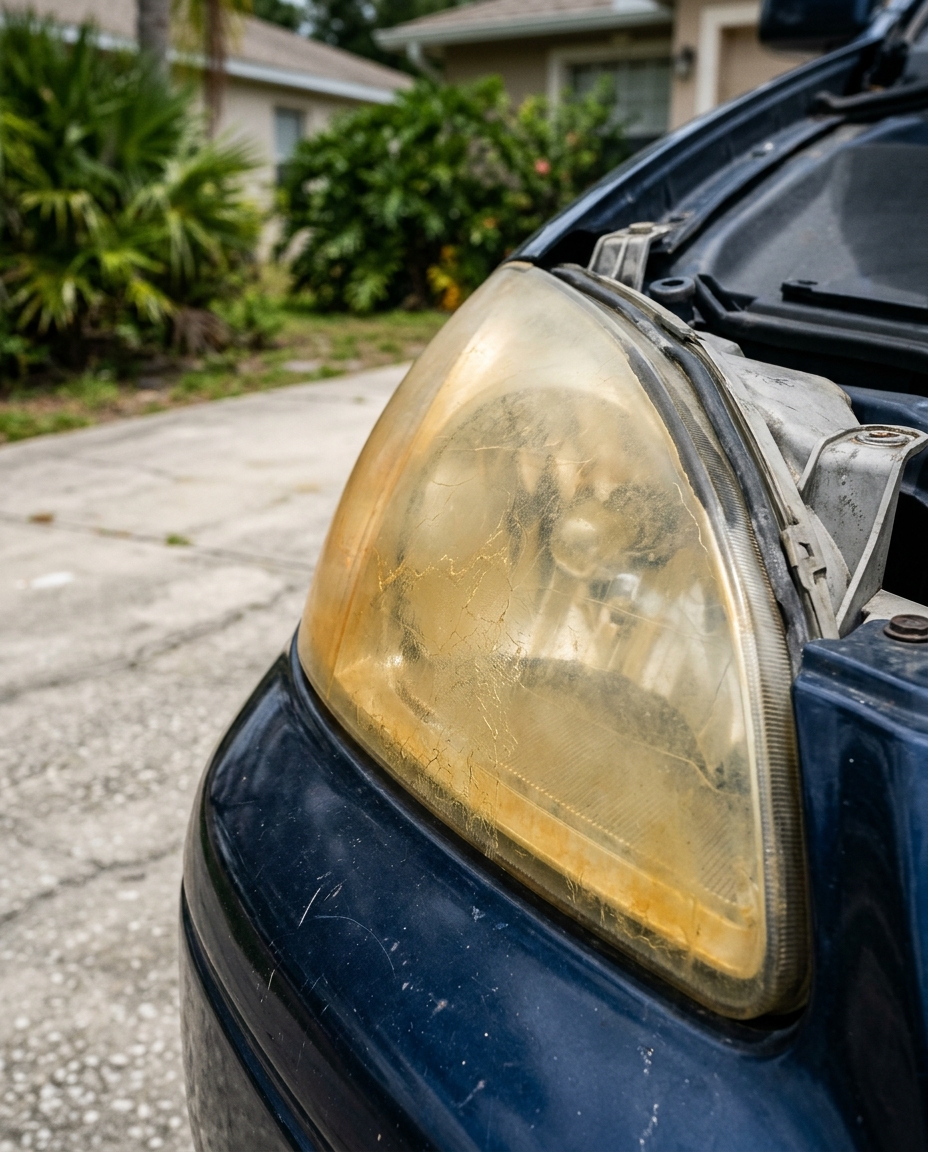
Most drivers notice yellowed headlights and put them on the same list as a scratched door sill — something to deal with eventually. The assumption is that they look bad but still work. That assumption is worth reconsidering now that the clocks have fallen back and you are driving home in the dark again.
What Oxidized Lenses Actually Do to Your Beam
New headlight lenses are clear polycarbonate. Florida UV is aggressive year-round, and polycarbonate breaks down from the outside in. The oxidized layer that makes lenses look yellow is not just surface discoloration. It scatters light. Instead of projecting a focused beam onto the road ahead, your headlights disperse light in multiple directions — including up into oncoming drivers’ eyes. What actually reaches the pavement in front of you is a fraction of what a clear lens would throw.
Testing on heavily oxidized lenses has found light output well below 50% of original. The lenses on a ten-year-old Florida vehicle that have never been restored are frequently at that stage or worse. The car still passes a safety inspection because the headlights technically function. That is not the same as saying they perform.
A Simple Test Worth Running
On a dark evening, park in front of a wall or garage door and shine your headlights at it from about 20 feet. Clear lenses project a sharp, bright white patch with a defined upper edge. Yellow lenses produce a dim, diffuse glow with no real edge to it. That edge matters. It is how your eyes find the road boundary at speed, and it is the first thing to disappear when lenses degrade.
You can also compare how the beam looks from outside the car. If a family member takes a photo of your headlights on a dark driveway, you will often see more yellow than you expected. Drivers are rarely in a position to look at their own headlights objectively.
Why November Changes the Stakes
Daylight saving ended November 1. Your evening commute, which was happening in full daylight a few weeks ago, is now dark. Same road, same speed, different light. If your headlights have been deteriorating through a full Florida summer of UV exposure, you are heading into the worst months for visibility with the least capable lights on your car.
The timing also works in your favor. November through January is one of the better windows to get restoration done. The UV load is lower, so a fresh sealant holds longer, and the work is easier to fit into a schedule before the spring pollen push starts putting fresh surfaces to the test right away.
What Restoration Actually Involves
Headlight restoration is surface work. It removes the oxidized outer layer and seals what is left underneath. The polishing step is the part most people know about and the part most DIY kits cover. The step that determines how long the result lasts is UV protection applied after the polish. Without it, bare polycarbonate re-oxidizes within months under Florida’s sun. With a proper UV sealant, a restored headlight can hold for a year or more before it needs attention again.
DIY kits vary significantly in what they include and how they perform. Some are adequate for mild oxidation. For lenses that are deeply yellowed or crazed on the surface, the results tend to be uneven and short-lived. Professional restoration covers both lenses at once so your illumination stays consistent, and the sealant applied is typically more durable than what comes in a kit.
When Restoration Is Not the Answer
There is a point of deterioration where the damage is internal. Moisture intrusion, crazing, or cracks in the lens itself cannot be addressed from the outside. External oxidation can be sanded and polished. Internal damage cannot. If your lenses have visible cracks, fogging inside the housing, or severe crazing on the surface, the conversation shifts from restoration to replacement, which is work for a body shop or auto parts supplier rather than a detailer.
Most Florida lenses that have yellowed but are still physically intact are good candidates for restoration. The goal is catching them before they reach the other category — and before shorter days turn a cosmetic delay into a visibility problem you are living with every evening.