Salt Air Keeps Damaging Your Paint Even After You Wash
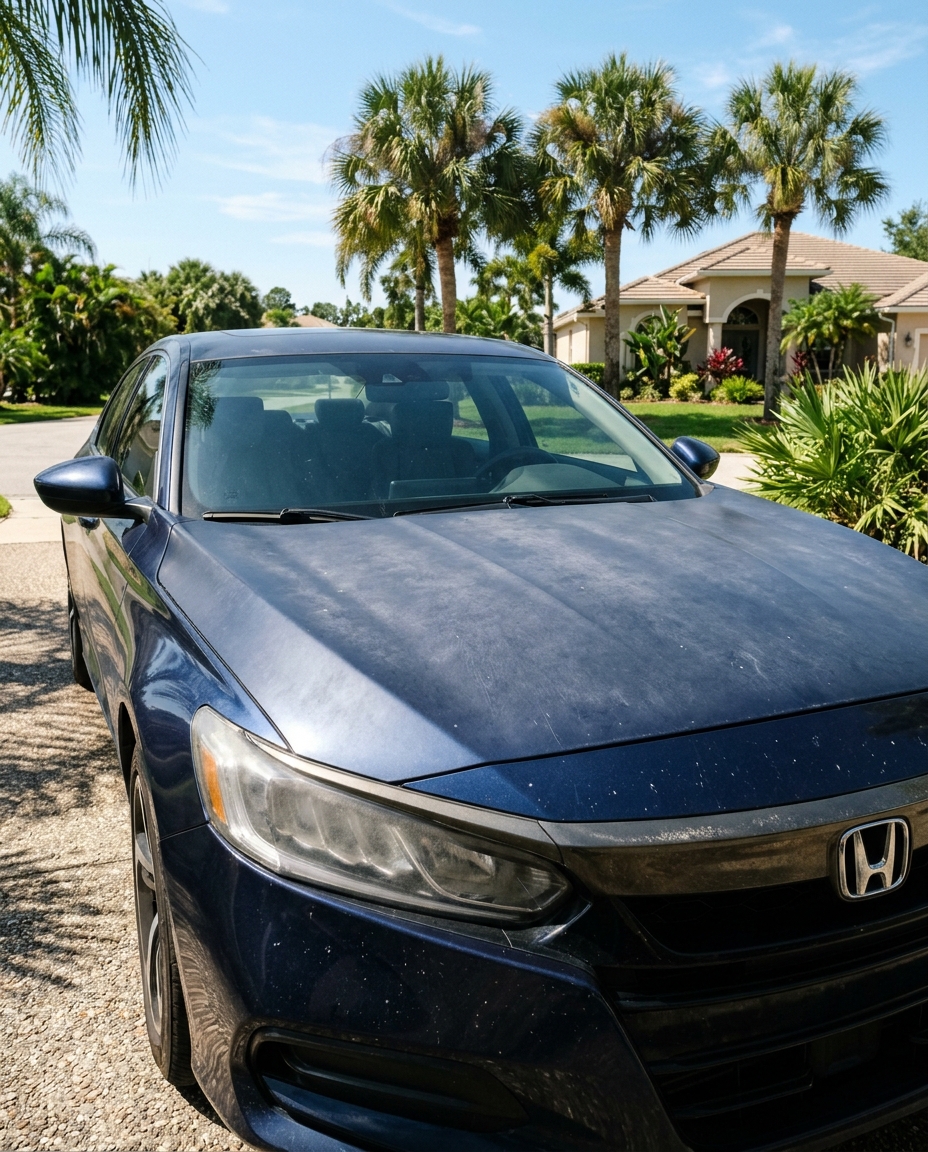
If you live near the coast — and most of the Space Coast is near the coast — you’re probably washing your car more than drivers in other parts of the country. That is a reasonable response to salt air. The problem is that washing removes what is on the surface of your paint. It does not stop what has already bonded to it.
What a wash actually removes
A regular wash does real work. It removes the loose salt haze, the dust, the bird droppings, the layer of grime that collects between washes. If you are skipping washes on a coastal car, that is a problem the wash fixes. But what it cannot remove is the salt and mineral deposits that have already worked their way into your clear coat.
Your clear coat is not a sealed surface. It has microscopic texture and pores, and over days and weeks of salt air exposure, fine particles settle in and bond. The wash that follows removes the new, loose deposits on top — not the older ones already attached to the coating. Each week, a little more bonds in. The paint looks clean after a wash because the surface layer is clean. What is underneath it is not.
How the damage actually progresses
Salt is mildly acidic, and left in contact with your clear coat, it slowly etches in. Florida’s UV compounds this — ultraviolet light degrades clear coat over time, and a weakened clear coat is more vulnerable to what salt air is doing. Living near the Atlantic or the Banana River means your car gets both, every day.
The early sign is dullness. The finish looks clean but flat — it does not have the depth or reflection it had when the car was newer. Run your hand over the paint after a wash and dry. If it feels rough or gritty rather than smooth, that is bonded contamination sitting in the clear coat. That texture is not removed by washing. It requires a different step.
What actually addresses it
Decontaminating the clear coat requires a clay bar treatment — a process that physically pulls bonded particles out of the paint surface without scratching it. It is the step between a good wash and a protective sealant, and it is what makes a sealant bond correctly rather than sitting on top of a contaminated surface and offering half the protection it should.
After decontamination, a paint sealant creates a barrier between the clear coat and the ongoing exposure. That barrier is not permanent — it needs to be renewed periodically depending on the product and how much the car is driven near the coast. The point is that the barrier does the job washing cannot: it gives salt air something to attack that is not your clear coat.
When it is time to call a professional
If the paint still feels rough or gritty after a thorough wash, the clay bar stage is overdue. If the finish looks dull or hazy rather than glossy, bonded contamination is already affecting the surface and washing will not shift it. And if there are chalky or oxidized patches, that is past what a detailing spray or wax can address — the clear coat has taken actual damage.
The earlier you deal with it, the simpler the fix. Address bonded contamination and add a sealant now, and the paint stays intact. Wait until oxidation sets in, and the conversation shifts to paint correction — a more involved job that is worth avoiding if the timing works in your favor.
We detail on-site throughout Palm Bay, Melbourne, Viera, Rockledge, Cocoa Beach, Merritt Island, Micco, and Fellsmere. Our exterior services include clay bar treatment, paint decontamination, and sealant application — we come to your home or office, no drop-off needed. If your paint has not had a proper decontamination in the last year, it is worth getting it looked at. Call us at (321) 381-0091 to book a detail.