What Swirl Marks Are Telling You About Your Car's Paint
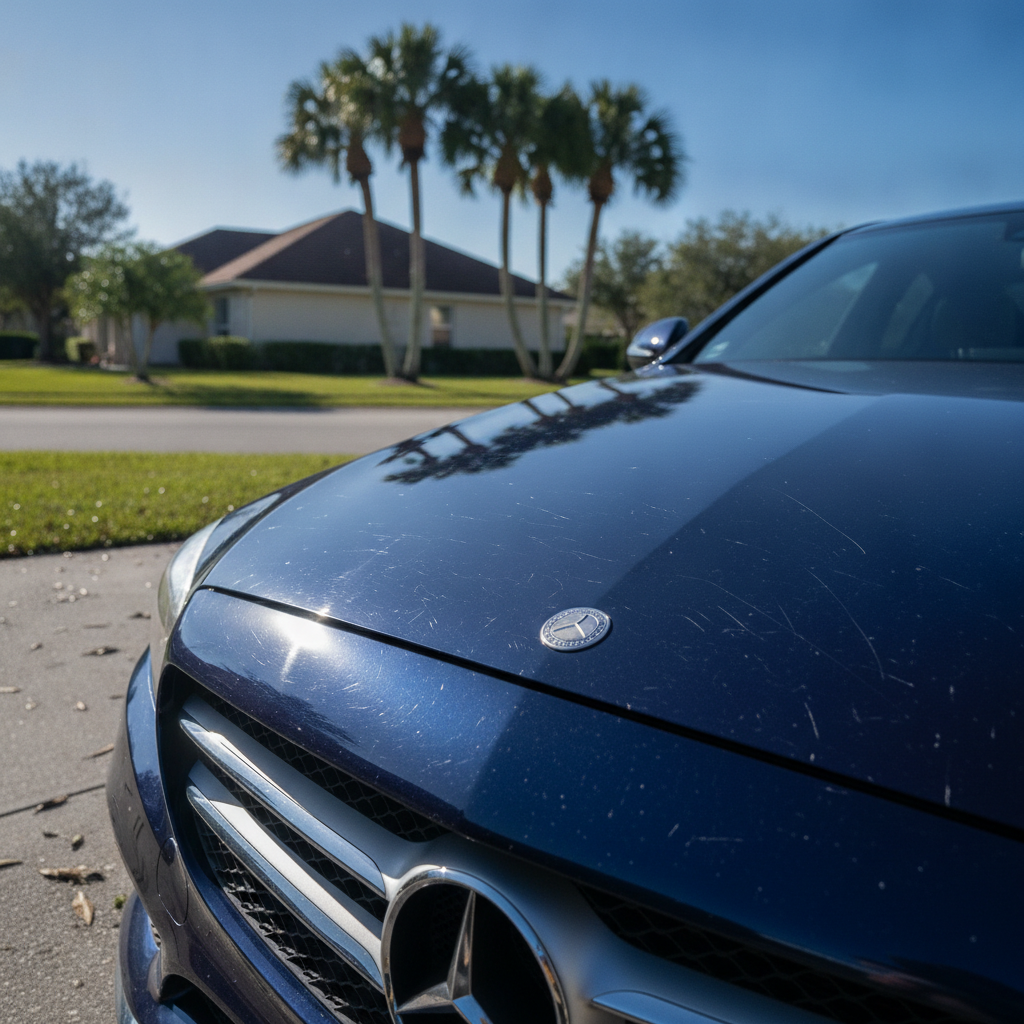
If you've ever walked around your car on a sunny Brevard morning and noticed fine circular scratches swirling across the hood or roof in the sunlight, that's not just light playing tricks. Those are swirl marks — and in Florida's unfiltered UV, they show up fast and age even faster.
What Swirl Marks Actually Are
Modern cars have a clear coat — a transparent layer that sits on top of your color paint and protects it. Swirl marks are fine scratches in that clear coat, too shallow to feel with a fingernail but deep enough to scatter light and dull the paint's reflectivity. They're most visible in direct sunlight or under a bright light at a low angle.
They don't come from crashes or curb-scrapes. They come from everyday habits: automatic car washes with spinning brushes, wiping a dusty car with a dry cloth, using a cheap wash mitt, even drying with a rough towel. Small careless moments stack up, and what was a crisp shine slowly becomes a hazy, flat-looking finish.
Why Florida Accelerates the Problem
The Space Coast is hard on clear coat. Intense UV exposure breaks down the molecular structure of clear coat over time, making it softer and more prone to scratching. If you park outside — and most of us do — you're getting hit year-round with UV levels that a car in a northern state only sees at peak summer.
Add fine grit from sandy beach days, the micro-abrasive pollen that settles thick in spring, and the silica particles left behind when Brevard's hard water evaporates off a wet car, and you've got a surface under constant low-level attack. The damage shows up first and most clearly on dark-colored cars, where swirl marks stand out sharply against the deep background.
Can You Prevent Them?
To a degree, yes. The single biggest change most people can make is switching from automatic car washes to a two-bucket hand wash — one bucket with soapy water for washing, one clean bucket for rinsing your mitt between passes, so you're not dragging grit back across the paint. A quality microfiber wash mitt instead of a sponge helps too, since sponges trap grit against the surface.
Keeping a paint sealant or wax on the car adds a sacrificial layer above the clear coat. It won't remove existing swirl marks, but it slows how fast new ones form. In Florida's sun, a sealant that might last a year up north often needs refreshing every six months or so.
When Washing and Waxing Won't Fix It
Here's the honest part: if the swirl marks are already there, better wash technique and wax can't undo them. Sealants sit on top of the clear coat — they can't fill in scratches that are cut into the surface below. To actually remove swirl marks, you have to lightly abrade the clear coat to level it out. That process is called paint correction.
Paint correction ranges from a single-step polish to a full multi-stage correction, depending on the depth and density of the scratches. It's done with a machine polisher and progressively finer compounds. The results on a heavily swirled dark car are dramatic — the kind of difference that looks like the paint was replaced. It does require skill and the right equipment, because an overly aggressive pass can cut through the clear coat entirely, which makes the problem worse, not better.
A Few Things Worth Understanding Before You Decide
Not every car needs a full correction. If swirl marks are light and the paint is otherwise in decent shape, a one-step polish can knock them back significantly without a lot of time or cost. If the clear coat is heavily oxidized — chalky, faded, or starting to peel — you're looking at a more involved process, and in some cases a respray makes more sense than correction.
Clear coat thickness matters here too. Newer cars tend to have more material to work with. A high-mileage car that's lived outside in Brevard sun and gone through years of automatic washes may have thinner clear coat — worth knowing before any correction work starts, because there's a limit to how many times a panel can be corrected.
A lot of people follow paint correction with ceramic coating, which lays down a harder, more scratch-resistant surface above the freshly corrected clear coat. Whether that's worth it depends on how you use the car, where you park, and how long you plan to keep it. Neither correction nor coating is a one-size decision.
If your paint is already showing heavy swirl marks and you want an honest read on what it would take to fix it, paint correction is quote-only — the price depends on the vehicle's size, paint condition, and what level of work makes sense. Brevard County Mobile Detailing can assess it and give you a real number: (321) 381-0091.
Whatever you decide, tightening up your wash routine now is free and the most effective thing you can do to slow further damage — no matter what state your paint is currently in.