What Tree Sap and Bird Droppings Do to Your Car's Paint
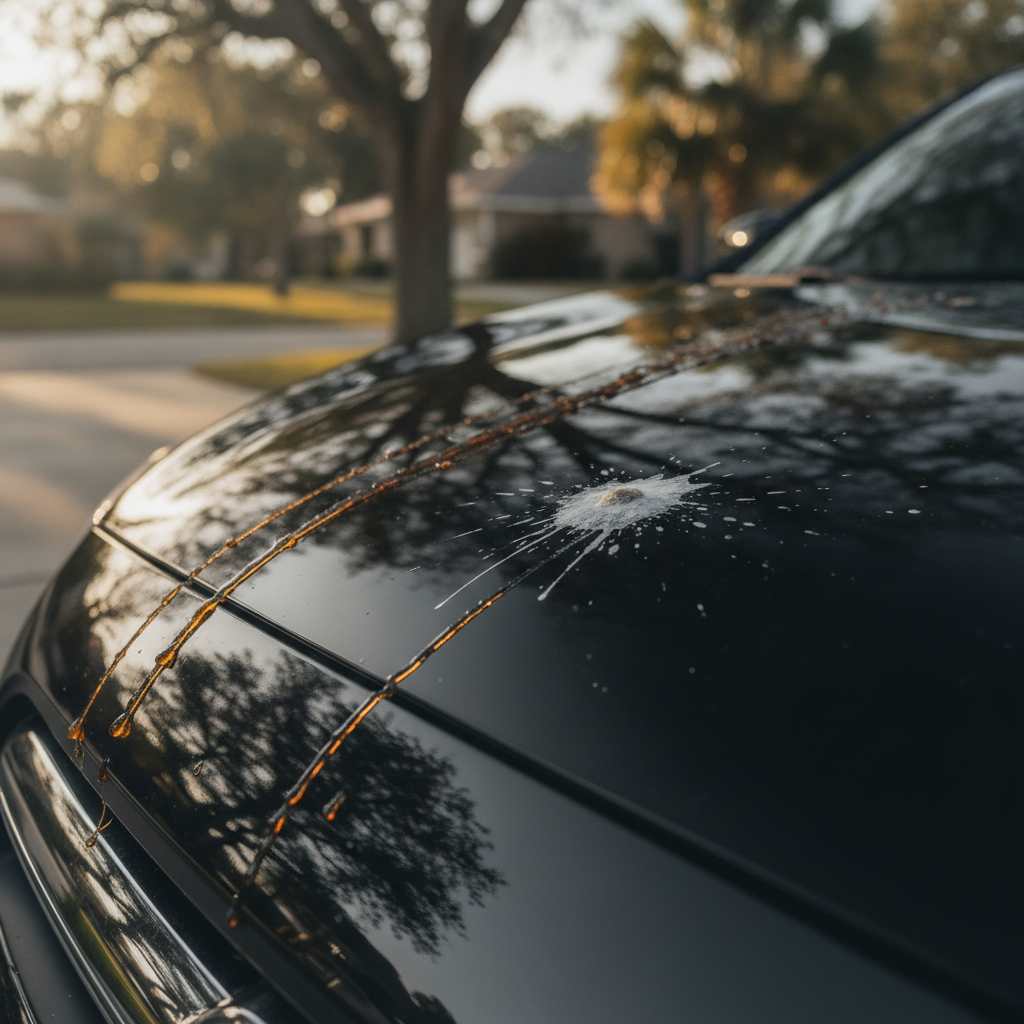
Parking under a live oak or pine in Brevard sounds like a good idea — shade is shade when it's 95 degrees out. But if you come back to sticky amber streaks or chalky white spots on your hood, you've traded one problem for another. Tree sap and bird droppings look like minor annoyances. In Florida's summer heat, they're paint killers.
Why Florida Heat Makes This Worse
Paint damage from organic deposits is a temperature problem as much as a chemistry problem. Bird droppings are acidic — uric acid, specifically — and in direct Florida sun, that acid etches into your clear coat faster than you'd expect. The same process that takes days in cooler climates can happen in a few hours on a Brevard afternoon in July.
Tree sap works differently. Fresh sap is sticky but removable. The problem is what happens when it bakes. Florida's UV and heat essentially cure the sap onto your paint, bonding it to the clear coat the same way lacquer hardens. The longer it sits, the harder it becomes to remove without causing damage.
The Wrong Way to Remove Both
The instinct is to scrape. Don't. A fingernail, a key, even a plastic card dragged across dry, baked-on sap will scratch your clear coat before the deposit budges. Same goes for dry paper towels — they abrade the surface and grind any grit right into the paint.
The second mistake is spraying with a hose and wiping immediately. You're adding friction to a surface that's still mostly dry underneath the softened top layer. It feels like you're cleaning it, but you're really just smearing it around and scratching at the same time.
How to Remove Tree Sap Without Wrecking the Paint
Soften it first. Isopropyl alcohol — 70% or higher — applied to a clean microfiber cloth and held against the sap for 30 to 60 seconds breaks the bond without stripping your wax. Gently wipe in one direction. Don't scrub in circles. For stubborn spots, a dedicated tar-and-sap remover works even better; it's pH-balanced for automotive clear coat and won't leave a residue.
If the sap has been sitting long enough to feel truly cemented, a clay bar is your next step. Pull it across a lubricated surface — always with clay lubricant, never dry — and it will lift bonded contaminants without scratching. This is the same step detailers use before applying a sealant, and it's worth doing if the spot feels rough even after the alcohol treatment.
Bird Droppings: Timing Is Everything
With bird droppings, the clock starts the moment they land. A fresh dropping on a cool morning hood is fairly forgiving. The same dropping baked onto black paint in the July sun for two or three hours is a different situation entirely — it can leave a visible etch mark even after you clean it off.
Keep a small bottle of quick-detailer spray and a couple of folded microfiber cloths in your car for exactly this. Spray the dropping, let it soak for a minute to re-hydrate, then gently lift it off without scrubbing back and forth. If you're away from home and don't have anything on hand, even a splash of water from a bottle and a soft cloth is better than waiting until you get back to the driveway.
After Removal: Don't Leave It Bare
Once you've cleaned the spot, that section of clear coat has been exposed. A quick pass of spray wax or detailing sealant over the cleaned area gives some protection while you're not set up to do a full treatment. It's not a substitute for a proper wash and wax, but it's better than leaving bare clear coat sitting in the Brevard sun.
If you notice a dull, hazy patch or a faint texture change after cleaning a bird dropping, that's etching that's already into the clear coat. A light polish can level it out, but it's past the point of a simple clean and protect. Worth knowing if you park under the same oak tree every day.
A Note on Parking Choices
No shade tree is worth the paint damage if your car is sitting under it for hours every day. A breathable car cover is one solution when covered parking isn't available. If you're near the coast — Cocoa Beach, Melbourne Beach, Indialantic — you've also got salt in the air mixing with the sap and droppings, which makes the chemistry even harder on your clear coat.
A quality paint sealant or wax creates a sacrificial layer between those deposits and the actual clear coat, making cleanup easier and reducing the risk of etching when removal is delayed. It won't stop everything, but it buys you time — and on a Space Coast summer, that's what you're really protecting against.