What Salt Air Is Doing Under Your Car (Not Just to the Paint)
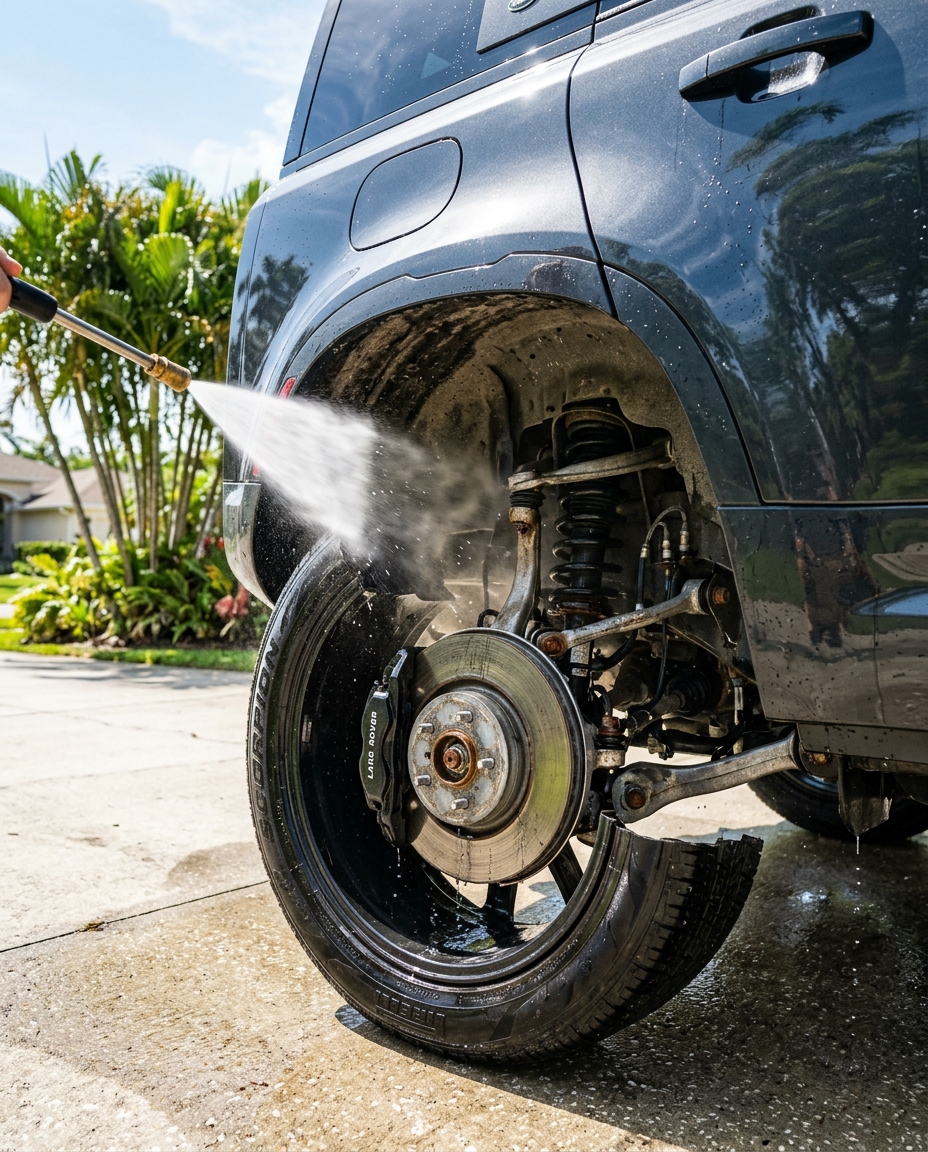
Most drivers pay attention to what salt air does to the paint. And it does real damage there — the finish, the trim, the door jambs. But while your eye is on the outside of your car, the bottom of it has been sitting in direct exposure all summer, and that's where the chemistry tends to do its quiet work.
Why the Undercarriage Gets the Worst of It
Salt does not just settle from above. Every time you drive through a puddle after an afternoon storm, or roll through ocean mist on the coastal roads heading into Cocoa Beach or Merritt Island, salt-laden water sprays up into the wheel wells, coats the brake components, and settles into the crevices of the frame. The paint on your hood might look fine because you're looking at it and rinsing it. The subframe is not getting the same attention.
Frame channels and structural points can trap standing water — especially in Florida's flat drainage conditions. That water carries chloride from salt air, and chloride on bare metal starts corrosion faster than most people expect. In inland climates, road salt is a winter problem. On the Space Coast, you're dealing with it twelve months a year.
Brake Hardware Is Especially Vulnerable
Rotors flash-rust between every use — that's normal, and it clears itself once you drive. The larger concern in coastal environments is the rest of the hardware: caliper slide pins, bracket bolts, anti-rattle clips, and brake dust shields. These are steel components packed into tight spaces with nowhere for moisture to go, and they see the full spray from every wet road you drive.
Dust shields — the thin steel plates sitting behind each rotor — rust through surprisingly fast near the coast. They are not structural, but once they perforate or start to crack, they can make contact with the rotor and cause noise or drag. It's the kind of thing that surfaces at a brake inspection and surprises people, because it was never on their radar. Nobody's checking the dust shield when they wash the car.
Wheel Wells Collect More Than You Think
Wheel well liners trap debris, organic material, and moisture in the gap between the liner and the inner fender. In a coastal climate, what gets trapped is salt-saturated. The liner itself holds up fine, but the metal it's protecting can corrode behind it where you would never see it until the liner gets pulled for an inspection.
This is not exclusive to the beach towns. The morning sea breeze off the Atlantic carries further inland than most people think. Melbourne, Viera, and Rockledge are not beachfront, but they see the same salt-heavy air by mid-morning on a typical summer day. The exposure is less dramatic than parking a block from the ocean, but it adds up over a full season the same way.
What a Proper Undercarriage Rinse Actually Does
A genuine undercarriage rinse — low pressure, thorough, covering the wheel wells and the frame rails — removes the surface deposit and reduces the concentration of chloride sitting against the metal. Most drive-through washes include an undercarriage spray, but it's rarely thorough enough to get into the tight spots where the spray has to arc upward from a fixed nozzle.
The difference between a wash and an actual rinse is pressure, angle, and coverage. It's worth checking whether whoever handles your car is actually addressing the wheel wells, or just spraying at the undercarriage from a fixed position below the car's center.
Fall Is a Natural Checkpoint
You've put a full summer on the car — beach trips, coastal errands, afternoon thunderstorms, six months of Atlantic salt air building up with nowhere obvious to show itself. Fall is a reasonable time to look at what accumulated underneath, even if the paint still looks fine. The paint is the easy part to inspect. The harder-to-see surfaces are where the damage usually starts, and where it's been running quietly all season.