Why Beach Sand Is Still in Your Car — Even After You Vacuumed
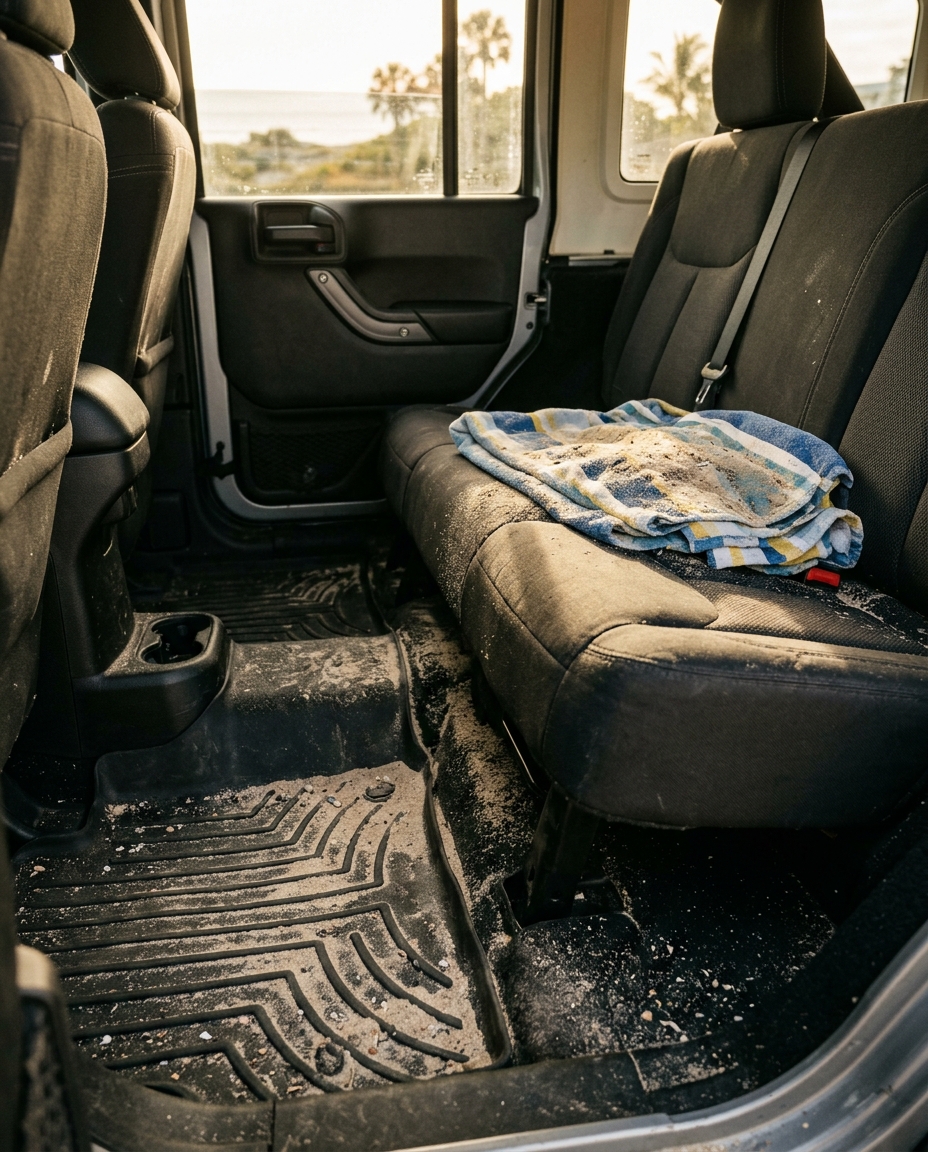
If you spent any time at Cocoa Beach, Sebastian Inlet, or any of the barrier island beaches this summer, your car knows it. Sand gets tracked in with every trip, shaken off towels, and worked into the carpet fibers by everyone climbing in and out. The standard response — a shop vac pass or a home vacuum run on a Sunday — feels like it handles the problem. It mostly does not.
Why Vacuuming Barely Scratches It
Fine Florida beach sand behaves differently from regular household dirt. Its small particle size lets it work down through carpet fibers rather than sitting on top of them, and once it is past the surface pile, suction alone will not pull it back out. You are lifting the visible layer. The embedded layer stays put.
The same thing happens in seat seams and the junction between seat cushions and seatback foam. Sand settles into those gaps every time someone shifts their weight or climbs in and out. Vacuuming the seat surface picks up what is sitting loose — not what is packed into the crease.
What Sand Does to an Interior Over Time
Fine abrasive particles work into carpet backing and accelerate wear in ways you will not notice until the carpet starts thinning in the same spots everyone plants their feet. Leather seats take it differently — sand sits in the grain and acts as a mild abrasive every time someone slides across. If your leather was already drying out from months of Florida UV and heat, that abrasion compounds the damage rather than starting a separate problem.
Sand in the cargo area tends to go ignored the longest. If you had wet beach gear, damp towels, or a sandy dog back there through the summer, the moisture works with the sand to create conditions where bacteria and mold spores build quietly. By November, that process has had months to progress.
The Spots Most Drivers Miss
Even drivers who vacuum after every beach trip hit the same blind spots. Under the front seats — where sand falls through the gap between the seat base and the floor rail — is one. Door sills, the slot between the sill and the carpet edge, and the trim running along the base of the seats are others. Sand packs into these areas and does not respond to surface vacuuming at all.
If your car has a trunk liner or cargo mat, lift it. Sand collects between the liner and the metal floor, stays damp longer than you would expect, and rarely gets noticed until there is already an odor you cannot locate. The mat looks clean from above. The problem is underneath it.
What Actually Gets It Out
Thorough extraction combines compressed air blown into seams and gaps to dislodge packed particles, followed by high-powered extraction vacuums — not shop vacs — that move enough airflow to pull fine particles up through carpet pile. For seats, the process works the seams, not just the surface. Cargo areas with any sign of moisture get treated for odor and bacteria at the same time.
Steam cleaning works sand loose from carpet backing and seat fabric while handling the bacteria and mold spores that accumulated alongside it. It is not a cosmetic step — it addresses what a dry vacuum pass leaves behind.
If your car was a regular passenger on Space Coast beach runs this summer, there is a good chance it needs more than another vacuum pass before the season changes. We come to your home or office — call (321) 381-0091 to book an interior detail and let us see what the season actually left behind.