Why Sprinkler Water Spots Won't Wipe Off Your Paint
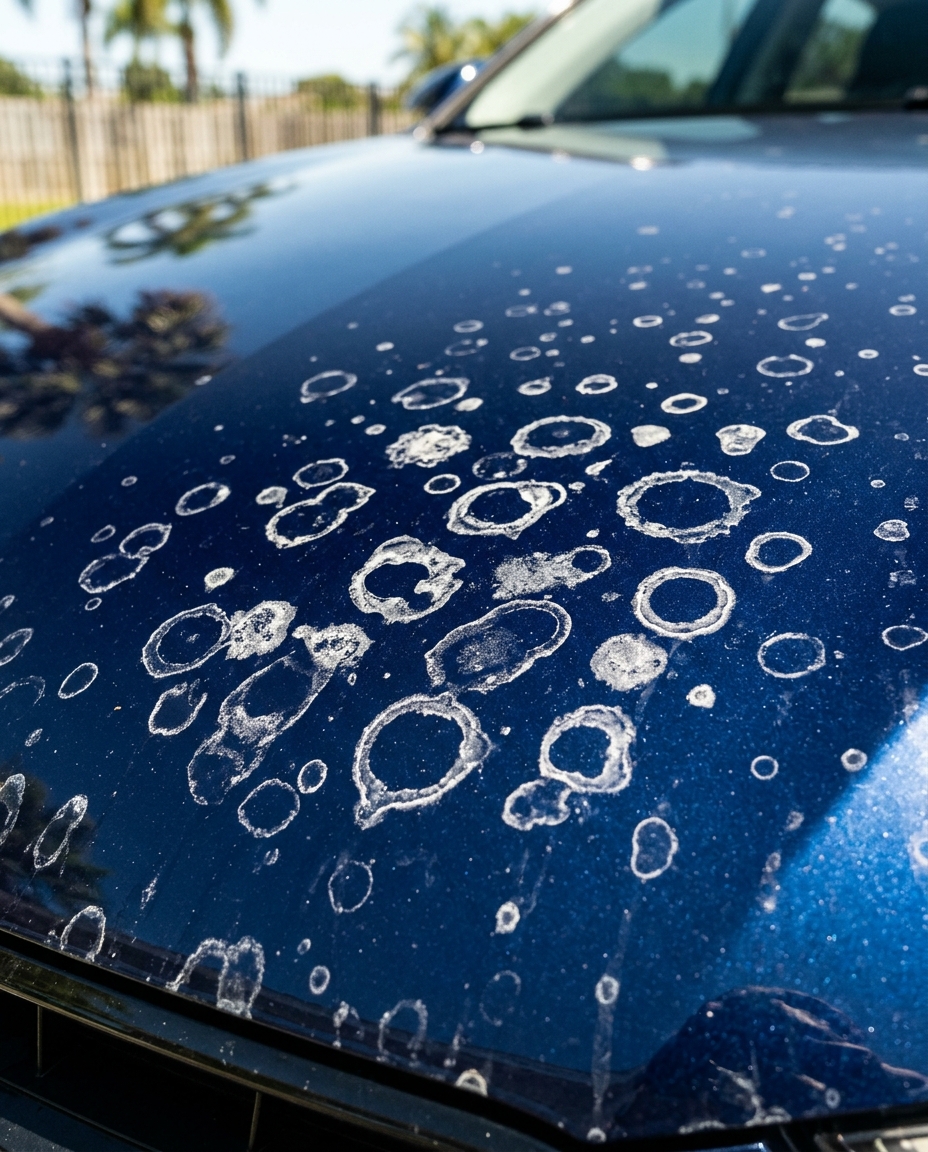
If you park in a driveway near a lawn irrigation system, you've seen those round, filmy spots on your paint the next morning. Most drivers either ignore them until the next wash or reach for a microfiber cloth and start wiping. Both approaches leave something behind that neither one removes — and in Florida's water, that something can permanently damage your clear coat.
What's Actually in the Water
Tap water and irrigation water throughout Brevard County and the Space Coast carry dissolved minerals — primarily calcium and magnesium, and in areas with well-fed irrigation systems, sometimes iron. When that water hits your paint and evaporates, the water disappears but the minerals stay behind. That's what a water spot is: not dried water, but dried minerals bonded to your paint's surface.
The minerals left by hard water are alkaline. They're not sitting loosely on top of your clear coat — they're adhered to it. Running a dry cloth across them doesn't lift them; it just smears them around, and if there's any grit mixed in (Florida has plenty), you're adding fine scratches to the equation.
The Window Before It Gets Worse
Fresh water spots are mineral deposits on the surface. Given enough heat and UV exposure — and Florida has both in abundance — those deposits can start to chemically etch into the clear coat itself. The spot stops being a surface issue and becomes a structural one. You'll notice this when the mark remains visible even after a proper wash: that's not residue anymore, that's damage.
The etching timeline depends on how hard your water is and how hot it is when the water evaporates. A spot that dries in full midday sun can start etching within hours. Sprinkler spots on a car sitting in shade overnight are slower. But leaving them for a week and expecting a wash to clear them up is how surface deposits become permanent marks.
What Actually Removes Them
For fresh spots, a diluted solution of white vinegar and water — roughly one part vinegar to three parts water — neutralizes the alkaline minerals and helps them release from the surface. Apply it, let it sit for 30 to 60 seconds, then rinse thoroughly. Don't let straight vinegar dwell too long; your clear coat doesn't need prolonged acid exposure either.
For spots that have been there a few days, a dedicated water spot remover product works better than vinegar. These are formulated specifically for mineral deposits and are safer to use without the timing precision vinegar requires. Apply per the instructions, buff lightly with a clean microfiber, and rinse well.
If the spots have been there longer and still show after the above, a clay bar treatment can lift them mechanically. Clay bar is the same process used to remove bonded contamination before a wax or sealant application — it gently pulls the deposit off the surface without scratching. After claying, apply a fresh sealant or wax, since clay strips any protection that was there.
If the spots are etched — visible as dull patches even on clean, dry paint — they require paint correction. That's a machine polishing process that removes a thin layer of clear coat to bring the surface level below the damaged area. It's not a hand-product job, and it's not something to attempt without the right equipment and experience.
Staying Ahead of It
The simplest step is a quick rinse with plain water after your car gets hit by the sprinkler. You don't need soap — you just need to dilute and move the mineral-rich water off the surface before it dries. If you can't rinse right away, parking in shade slows the rate at which spots set and etch.
A good paint sealant or wax also helps. Neither makes your car immune to water spots, but they create a sacrificial layer between the minerals and your actual clear coat, making spots easier to remove and slower to etch. On the Space Coast, where irrigation systems run year-round and hard water is the norm rather than the exception, that extra barrier makes a real difference over time.