Why Water Spots Are Harder to Fix Than You Think
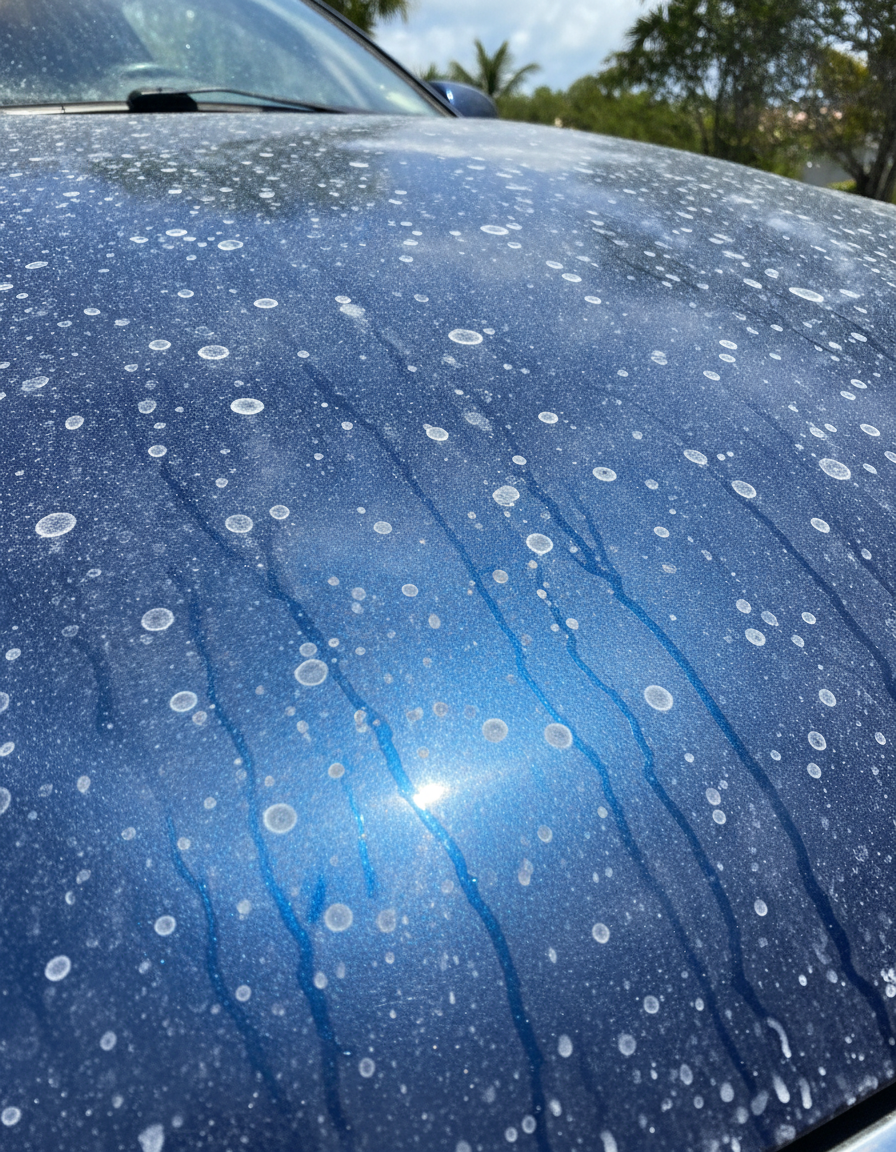
There’s a version of this problem most Brevard County drivers have seen: the irrigation sprinklers hit the car overnight, it dries in the morning heat, and by the time you notice the spots they’re hazy and stubborn. The assumption is that water spots are just mineral residue sitting on top of the paint. In a lot of climates, that’s true. Down here, they’re often something worse.
What’s Actually in the Water
Most irrigation systems in Brevard pull from well water, which carries significant mineral content — mainly calcium and magnesium carbonates. When that water lands on your car and evaporates, those minerals don’t go with it. They stay behind as deposits on the paint surface, and they bond quickly in the heat.
The same thing happens with afternoon thunderstorm runoff. Rain picks up mineral dust from the air and roads, lands on your hood and roof, and leaves a residue as it dries. A summer’s worth of daily sprinkler exposure can build up dozens of overlapping layers of that residue without anyone noticing.
What Florida’s Heat Does to Those Deposits
Here’s where it gets worse. The mineral deposits can become mildly acidic as they dry and bake in the sun, and Florida’s surface temperatures accelerate a process called etching — where that acidity works into the clear coat, the transparent protective layer over your paint. What started as a surface deposit becomes a microscopic crater in the clear coat. That can’t be rinsed away.
A dark-colored hood in August can reach 160°F on a sunny afternoon. That’s enough heat to set a water spot that landed that morning. The longer it stays, the deeper it can go.
The Move Most People Make (That Makes It Worse)
The instinct is to wipe the spot off with a microfiber cloth or a paper towel. On a fresh spot before it dries, that can work. On a dried, baked-in mineral deposit, you’re dragging abrasive particles across the clear coat under pressure — which creates fine scratches that catch light and make the area look worse than the original spot did.
Household cleaners are another common attempt. Window spray, vinegar and water, multi-surface spray — some of these work on glass. On automotive clear coat, they can strip whatever protection is already there and may accelerate the etching rather than reverse it.
What Actually Removes Water Spots
Mild spots that haven’t etched yet respond well to a dedicated water spot remover or a diluted citric acid solution made for automotive use. The key is wet application with no rubbing pressure — let the product dissolve the mineral bond, then rinse before it dries on the panel. These products are available at auto parts stores and aren’t complicated to use if the spots are caught early.
For spots that have had time to set, a clay bar treatment is usually the next step. Clay lifts embedded contamination without scratching, but it requires proper lubrication, light pressure, and working in small sections. After claying you’ll need to reapply a paint sealant, because clay removes whatever protection was on the surface.
If the etching has gone deep enough, removal crosses into paint correction territory — light machine polishing to level the clear coat around the damage. That’s not a DIY job, and it won’t be undone by washing or waxing over it.
The Better Play in Brevard
Water spots are easier to prevent than remove. Parking away from irrigation zones when you can, drying your car after it gets wet instead of letting it air-dry in the sun, and keeping a paint sealant on the surface — these things make water spots a surface nuisance rather than a permanent problem. A quality sealant significantly slows how fast mineral deposits can bond to the paint.
If your car has that familiar hazy ring pattern across the hood and roof right now, that’s the summer sprinkler season showing up. The longer it sits, the harder it gets to reverse without professional correction.